Views: 0
-

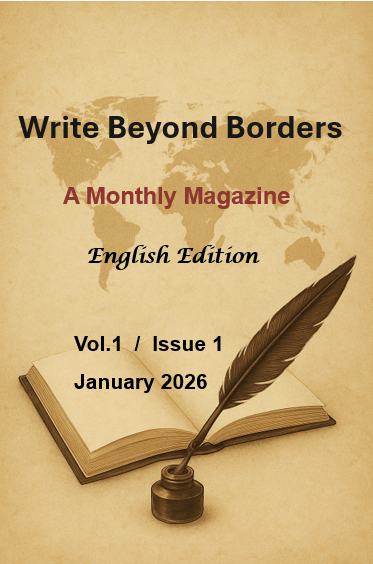
Magazine English
Write Beyond Borders
A Monthly Magazine
© 2026 Write Beyond Borders. All rights reserved.
No part of this publication may be reproduced, stored, or transmitted in any form or by any means—electronic, mechanical, photocopying, recording, or otherwise—without prior written permission of the publisher, except for brief quotations used in reviews, academic research, or critical commentary.
Edition: English
Volume: 1
Issue: 1
Month & Year: January 2026
Publisher: Write Beyond Borders
Website: https://write-beyond-borders.com
The views expressed in individual articles are those of the authors and do not necessarily reflect the views of the editorial board or publisher.
All language editions of Write Beyond Borders share the same intellectual spine, expressed through different cultural voices.
EDITORIAL & ADVISORY BOARD
(ENGLISH – Magazine Post)
Editorial Board
Editor-in-Chief
Sarwat Parvez
Author | Researcher | Editor
Founder, Write Beyond Borders
Responsible for overall editorial vision, policy, and final approvals.
English Editor
Dr. Jonathan Miles (London, United Kingdom)
Literary Critic | Global Affairs & Cultural Studies
Oversees English-language essays, research articles, and critical writing.
Urdu Editor
Prof. Arif Hussain (Lahore, Pakistan)
Urdu Scholar | Poet & Critic
Responsible for Urdu literature, poetry, fiction, and critical discourse.
Hindi Editor
Dr. Neha Verma (New Delhi, India)
Academic | Hindi Literature & Contemporary Studies
Oversees Hindi-language literary and analytical content.
Technical Editor
Ayaan Khan
Computer Engineer & IT Professional
Manages digital publishing systems, multilingual workflows, and platform integrity.
Advisory & Review Board (International)
The Advisory & Review Board provides academic guidance, peer review for selected submissions, and ensures intellectual integrity across disciplines.
- Prof. Michael Rosenfeld (Berlin, Germany)
Political Philosophy | Global Ethics - Dr. Ayesha Rahman (Karachi, Pakistan)
Gender Studies | South Asian Literature - Prof. Carlos Mendoza (Madrid, Spain)
Comparative Literature | Translation Studies - Dr. Fatima Al-Zahra (Cairo, Egypt)
History | Civilization & Islamic Thought - Dr. Richard Cole (Toronto, Canada)
Media Studies | Digital Culture
CONTENTS
Editorial
From the Desk of the Editor-in-Chief …………………………………. 1
The Age of Distraction: How Attention Became the Most Valuable Currency of the 21st Century-Sarwat Parvez
The Age of Distraction
How Attention Became the Most Valuable Currency of the 21st Century
— Jonathan Miles (London, UK) …………………………………. 4
Short Story
The Last Signal
— Ayesha Rahman (Karachi, Pakistan) ……………………………… 12
Global Affairs
Wars Without Battlefields: Conflict in the Digital Age
— Daniel Roth (Berlin, Germany) …………………………………. 18
History & Civilizations
Empires That Fell Without War
— Michael Grant (Oxford, UK) …………………………………. 25
Society & Culture
Why Stories Still Matter in a Noisy World
— Sophia Alvarez (Madrid, Spain) ………………………………. 31
Poetry Section
Three Poems on Silence and Time
— Kavita Sharma (Jaipur, India) …………………………………. 36
Philosophy
Does Meaning Require Belief?
— Omar Siddiqui (Toronto, Canada) ………………………………. 40
Science & Mind
The Psychology of Attention and Addiction
— Dr. Ethan Cole (Boston, USA) ………………………………….. 45
Humor / Satire
Laughing at Ourselves
— Nikhil Verma (Mumbai, India) …………………………………. 50
Closing Note
Write Beyond Borders: A Shared Space for Thought …………………… 54
EDITORIAL
Beyond Borders, Beyond Noise
We live in an age of abundance—of information, opinions, platforms, and voices.
Yet meaning has become scarce.
The world speaks endlessly, but listens rarely. Speed has replaced depth. Reaction has overtaken reflection. In this relentless current of immediacy, the quiet discipline of thinking has begun to feel almost rebellious.
Write Beyond Borders was born from this unease.
This magazine does not seek to compete with the noise. It seeks to rise above it.
Our aim is neither consensus nor provocation for its own sake. We believe that ideas deserve time, language deserves care, and disagreement deserves dignity. Thought, when freed from haste and hostility, becomes an act of responsibility.
To write is not merely to express—it is to choose.
To choose honesty over convenience.
Nuance over slogans.
Understanding over certainty.
This first issue brings together voices that differ in form, theme, and temperament, yet share a common commitment: to look beyond the immediate, beyond the fashionable, beyond the familiar. From reflections on attention and technology to stories rooted in history, culture, humor, and imagination, each contribution is an invitation to pause, to read, to consider.
Language, too, matters deeply to us. By publishing across English, Urdu, and Hindi editions, we affirm that thought does not belong to a single tongue. Ideas travel best when borders—geographical, linguistic, or ideological—are allowed to dissolve.
A magazine, at its best, is not a product but a conversation—one that unfolds over time. This issue is our opening sentence.
We invite you not merely to read, but to engage. Not to agree with everything, but to think carefully about something.
Because in an age that rewards distraction, attention itself has become an ethical choice.
Welcome to Write Beyond Borders.
Sarwat Parvez— Editor-in-Chief
Write Beyond Borders
January 2026
The Age of Distraction: How Attention Became the Most Valuable Currency of the 21st Century
The 21st century has transformed attention into one of the most valuable—and most contested—resources of modern life. In an era defined by constant connectivity, endless notifications, and an uninterrupted stream of content, human focus has quietly shifted from a natural faculty into a commodity. Every scroll, click, pause, and reaction has become measurable, monetized, and strategically pursued. Unlike previous ages that competed for land, labor, or capital, our time competes for the human mind itself.
Technology has not merely accelerated communication; it has restructured perception. Platforms are engineered to keep users engaged for as long as possible, rewarding immediacy over depth and volume over meaning. As a result, attention has fragmented. The ability to concentrate for extended periods—once essential for reading, learning, and reflection—has become increasingly rare. Distraction is no longer an interruption; it is the default condition. The mind moves rapidly from headline to headline, image to image, rarely settling long enough to absorb complexity.
This shift has profound cultural and psychological consequences. When attention is constantly divided, understanding becomes shallow. Ideas are consumed rather than examined, opinions formed before facts are weighed, and emotions triggered before thought can intervene. Public discourse suffers as nuance disappears, replaced by simplified narratives designed for immediate impact. In such an environment, outrage travels faster than reason, and visibility often takes precedence over truth.
Economically, attention now functions as currency. Advertisers, political movements, media outlets, and influencers all compete within the same crowded space, knowing that visibility determines influence. Algorithms quietly decide what is visible and what is hidden, shaping perceptions without our direct awareness. The value of a message is no longer determined by its depth or accuracy, but by its ability to interrupt, provoke, or entertain. What captures attention survives; what requires patience risks being ignored.
Yet within this landscape lies an ethical challenge. If attention is finite, then how it is spent becomes a moral decision. Choosing to read thoughtfully, to listen carefully, and to engage deeply is an act of resistance against a system that profits from distraction. Reclaiming attention means reclaiming agency—over time, thought, and identity. It requires slowing down in a world that rewards speed, and choosing reflection in a culture driven by reaction.
The age of distraction is not merely a technological condition; it is a test of consciousness. Whether attention continues to be fragmented and exploited, or consciously protected and directed, will shape the intellectual and cultural character of this century. In learning to guard our attention, we may rediscover not only the power of focus, but the deeper value of thought itself.
Sarwat Parvez
The Age of Distraction
How Attention Became the Most Valuable Currency of the 21st Century
Jonathan Miles
London, United Kingdom
Manuscript received: 12 December 2025
Accepted for publication: 28 December 2025
The twenty-first century has quietly transformed attention into one of the most valuable and fiercely contested resources of modern life. In an era shaped by constant connectivity, endless notifications, and uninterrupted streams of content, human focus has shifted from a natural faculty into a measurable commodity. Every scroll, click, pause, and reaction has become data—tracked, analyzed, and monetized. Unlike previous ages that competed for land, labor, or capital, our time competes for the human mind itself.
Technology has not merely accelerated communication; it has reshaped perception. Digital platforms are carefully engineered to maximize engagement, rewarding immediacy over depth and stimulation over reflection. As a result, attention has fragmented. The ability to concentrate for sustained periods—once essential for reading, learning, and critical thought—has become increasingly rare. Distraction is no longer an interruption to daily life; it has become its default state.
This transformation carries profound psychological and cultural consequences. When attention is constantly divided, understanding becomes shallow. Ideas are skimmed rather than examined, opinions are formed before evidence is weighed, and emotional reactions replace considered judgment. Public discourse suffers as nuance disappears, replaced by simplified narratives designed for immediate impact. In such an environment, outrage spreads faster than reason, and visibility often takes precedence over truth.
Economically, attention now functions as currency. Advertisers, media outlets, political movements, and influencers all operate within the same crowded digital marketplace, where influence is determined by visibility rather than substance. Algorithms quietly decide what is amplified and what is ignored, shaping perception without explicit consent. Messages that interrupt, provoke, or entertain are rewarded, while those that require patience or contemplation struggle to survive.
Yet this reality presents an ethical challenge. If attention is finite, then how it is spent becomes a moral choice. Choosing to read deeply, to listen carefully, and to think critically is an act of resistance against systems that profit from distraction. Reclaiming attention means reclaiming agency—over time, thought, and identity. It requires slowing down in a world that rewards speed and choosing reflection in a culture driven by reaction.
The age of distraction is not merely a technological condition; it is a test of consciousness. Whether attention continues to be fragmented and exploited, or consciously protected and directed, will shape the intellectual and cultural character of this century. In learning to guard our attention, we may rediscover not only the power of focus, but the deeper value of thought itself.
The Last Signal
Ayesha Rahman
Karachi, Pakistan
Manuscript received: 18 November 2025
Accepted for publication: 6 December 2025
The signal arrived at 2:17 a.m., sharp and deliberate, cutting through the silence of the room like a whisper that refused to fade. The phone vibrated once—no notification sound, no alert—just enough to wake her.
Zara stared at the ceiling for a long moment before reaching for the device. The room smelled faintly of dust and old paper. Outside, Karachi slept uneasily, its distant traffic reduced to a low, restless hum.
The message contained no words.
Only a blinking dot.
She knew what it meant.
Years ago, when the world still felt smaller and time more generous, they had agreed on this signal. If everything failed—if numbers changed, platforms vanished, or names became unsafe—one dot would mean I am still here.
Zara’s thumb hovered over the screen. She hadn’t responded to that signal in three years. Not since silence became easier than explanation.
She typed a single dot and paused. Then deleted it.
The past was not a place she could return to without cost.
Her phone vibrated again.
Two dots this time.
She closed her eyes.
Memory flooded in uninvited—late-night conversations carried by unstable connections, shared fears disguised as jokes, promises made lightly because the future felt endless. Back then, they believed distance was temporary and courage infinite.
They were wrong about both.
Outside, a stray cat knocked over a trash bin. Somewhere, a generator coughed to life. The city continued, indifferent to unfinished stories.
Zara typed again.
One dot.
Sent.
The response came instantly.
Three dots.
Her breath caught. That was new. They had never agreed on three. Improvisation meant urgency.
She stared at the screen as words finally appeared.
“This may be the last time.”
She felt a familiar tightening in her chest—the ache of knowing that some connections survive not because they are strong, but because they refuse to die quietly.
She replied.
“Last times still matter.”
The dots blinked, hesitated, then vanished.
No goodbye. No explanation.
The signal ended.
Zara placed the phone face down on the table and sat in the dark, listening to the city reclaim the night. Some connections, she realized, are not meant to be sustained. They exist only to remind us that once, we were seen.
And sometimes, that is enough.
Wars Without Battlefields
Conflict in the Digital Age
Daniel Roth
Berlin, Germany
Manuscript received: 22 November 2025
Accepted for publication: 10 December 2025
War in the twenty-first century rarely announces itself with marching armies or formal declarations. Instead, it arrives quietly—through screens, servers, supply chains, and narratives. The battlefield has expanded beyond geography into cyberspace, economies, and the collective consciousness of societies. Conflict today is less about territorial conquest and more about influence, disruption, and control.
Digital technology has fundamentally altered how wars are fought. Cyberattacks can disable power grids, paralyze hospitals, interfere with elections, and expose sensitive state secrets without a single soldier crossing a border. Unlike conventional warfare, these attacks often leave no clear signature. Attribution becomes difficult, accountability elusive. The absence of visible violence does not reduce the damage; it merely conceals it.
Information itself has become a weapon. Social media platforms, once celebrated as tools of connection, now serve as arenas for psychological operations. Misinformation spreads faster than verification, eroding trust in institutions, media, and even shared reality. Public opinion can be manipulated at scale, turning citizens into unwitting participants in conflicts they do not recognize as wars. In this environment, truth becomes contested territory.
Economic pressure has also replaced traditional force in many global confrontations. Sanctions, trade restrictions, and financial isolation are deployed to weaken states without firing a shot. While often presented as alternatives to war, these measures can devastate civilian populations, distort markets, and deepen global inequalities. Economic warfare blurs the line between diplomacy and aggression, raising ethical questions about responsibility and consequence.
The rise of remote and automated technologies further distances decision-makers from the human cost of conflict. Drones, surveillance systems, and algorithmic targeting reduce warfare to data points and probability models. When war is conducted from thousands of miles away, moral accountability becomes abstract. The suffering of civilians is rendered invisible, transformed into statistics rather than lived experiences.
Perhaps the most unsettling aspect of modern conflict is its permanence. Unlike traditional wars with defined beginnings and endings, digital and hybrid conflicts persist indefinitely. They fluctuate in intensity but rarely conclude. Societies remain in a constant state of low-level confrontation, normalizing instability as part of everyday life.
This transformation challenges existing international law and ethical frameworks. Rules designed for conventional warfare struggle to address conflicts without borders, uniforms, or declarations. As technology advances faster than regulation, the risk of escalation grows—not through dramatic invasions, but through cumulative disruption.
Wars without battlefields may appear less violent, but they are no less destructive. They reshape how power is exercised, how societies function, and how individuals understand security. In recognizing these new forms of conflict, the global community faces a critical task: to redefine accountability, protect civilians, and restore the primacy of human dignity in an age where war has become both invisible and constant.
Empires That Fell Without War
How Civilizations Collapse from Within
Michael Grant
Oxford, United Kingdom
Manuscript received: 15 November 2025
Accepted for publication: 8 December 2025
History often remembers empires by the wars they fought and the territories they conquered. Yet some of the most powerful civilizations did not fall to invading armies or dramatic final battles. They collapsed quietly—from within—undermined by internal decay rather than external force. These empires did not lose because they were defeated; they lost because they stopped understanding themselves.
The Roman Empire, frequently cited as the archetype of imperial collapse, did not fall in a single moment. Long before external pressures intensified, Rome struggled with corruption, economic inequality, political instability, and a widening gap between its ruling elite and ordinary citizens. Military strength remained formidable, but social cohesion weakened. When trust eroded and institutions lost credibility, the empire became vulnerable without realizing it.
Similarly, the Abbasid Caliphate reached extraordinary heights in science, culture, and governance, yet internal fragmentation proved fatal. Power struggles, court politics, and the weakening of central authority slowly dismantled unity. Provinces became autonomous, loyalty shifted from the state to factions, and intellectual vitality declined as political survival took precedence over vision. By the time external forces arrived, the empire had already hollowed itself out.
The Mughal Empire in South Asia offers another example. Its decline was not caused by immediate conquest but by administrative inefficiency, fiscal strain, and succession conflicts. The empire’s inability to adapt to changing economic and political realities weakened its foundations. As governance deteriorated, legitimacy faded. External powers did not topple the empire; they inherited its collapse.
What unites these histories is a pattern of internal neglect. Empires fall when institutions fail to renew themselves, when leadership prioritizes short-term control over long-term stability, and when justice becomes selective rather than universal. Cultural stagnation, economic imbalance, and loss of shared purpose often precede visible decline.
Modern societies are not immune to these lessons. Power today may look different—distributed across technology, finance, and influence rather than territory—but the principles remain unchanged. States that ignore social cohesion, erode trust, and dismiss ethical governance risk repeating historical patterns, even without traditional wars.
The fall of empires without war reminds us that collapse is rarely sudden. It is gradual, almost invisible, unfolding over generations. History does not merely record these declines; it warns against them. The question is not whether empires can fall without war, but whether modern civilizations are willing to recognize the signs before silence replaces strength.
Why Stories Still Matter in a Noisy World
Sophia Alvarez
Madrid, Spain
Manuscript received: 20 November 2025
Accepted for publication: 12 December 2025
We live surrounded by sound, yet meaning often feels distant. Notifications interrupt thought, headlines compete for attention, and opinions circulate faster than understanding. In this environment, stories may appear fragile—too slow, too subtle, too human. And yet, it is precisely in such times that stories matter most.
Stories are not information. They are interpretations. While data explains what happened, stories help us understand why it mattered. They place facts within emotional and moral contexts, allowing individuals to connect beyond statistics and abstractions. In a noisy world, stories slow the pace of consumption and invite reflection—a rare act in an age defined by immediacy.
Historically, societies have relied on stories to transmit values, preserve memory, and shape collective identity. Long before institutions and technologies, narratives carried knowledge across generations. They taught communities how to live, what to fear, and what to hope for. Even today, despite unprecedented access to information, humans continue to make sense of the world through narrative rather than numbers.
The dominance of digital media has altered how stories are told and received. Algorithms prioritize engagement, often rewarding shock over substance. As a result, narratives are compressed, simplified, and frequently distorted. Complexity becomes a liability. Yet genuine stories resist such reduction. They require patience, empathy, and openness—qualities increasingly marginalized by rapid consumption.
This tension explains why stories endure despite competing distractions. When people encounter a narrative that reflects their fears, memories, or unanswered questions, attention naturally follows. Stories remind us that behind every trend, conflict, or crisis are individuals navigating uncertainty. They restore human scale to overwhelming realities.
Moreover, stories create bridges across differences. They allow readers to inhabit lives unlike their own, crossing boundaries of language, culture, and experience. In polarized societies, this capacity is essential. Where arguments divide, stories connect. Where ideology hardens, narrative softens.
In a world saturated with noise, stories do not shout. They persist quietly, waiting for those willing to listen. Their power lies not in volume, but in resonance. As long as humans seek meaning rather than mere reaction, stories will remain indispensable—guiding attention away from chaos and back toward understanding.
Three Poems on Silence and Time
Kavita Sharma
Jaipur, India
Manuscript received: 10 November 2025
Accepted for publication: 30 November 2025
I. Silence
Silence is not empty,
it is crowded with things
we were too afraid to say.
It waits between sentences,
leaning against unfinished thoughts,
patient as dust on old books.
In silence,
truth learns to breathe
without interruption.
II. Time
Time does not move forward—
it circles us slowly,
like a question we keep postponing.
What we call the past
still sits quietly
inside our habits.
And the future
arrives disguised as repetition.
III. Between Moments
Between one moment
and the next,
something always slips away.
A thought,
a certainty,
a version of ourselves
we will never meet again.
We call this loss
time passing.
But perhaps
it is simply
life choosing what to keep.
Does Meaning Require Belief?
Omar Siddiqui
Toronto, Canada
Manuscript received: 25 November 2025
Accepted for publication: 14 December 2025
The search for meaning is among the oldest human pursuits. Across civilizations, cultures, and belief systems, people have asked variations of the same question: Why are we here, and what makes life matter? For many, belief—religious, spiritual, or metaphysical—has provided an answer. For others, meaning is constructed without reference to faith. The tension between these positions continues to shape philosophical thought.
Belief has traditionally offered a framework that situates individual lives within a larger narrative. Whether grounded in divine purpose, moral order, or cosmic design, belief systems provide coherence. They explain suffering, justify ethical obligations, and promise continuity beyond individual existence. In this sense, belief does not merely supply meaning; it organizes it.
Yet modern philosophy challenges the assumption that belief is a prerequisite for meaning. Existential thinkers argue that meaning is not discovered but created. According to this view, life has no inherent purpose imposed from outside. Instead, meaning emerges through choice, responsibility, and engagement with the world. To live meaningfully is not to accept a given explanation, but to act authentically despite uncertainty.
This shift places a heavy burden on the individual. Without belief, there is no guaranteed moral compass or ultimate reassurance. Freedom becomes inseparable from anxiety. The absence of absolute meaning forces individuals to confront their own limitations and finitude. For some, this confrontation leads to despair; for others, it becomes a source of profound honesty.
The debate, however, is not as binary as it often appears. Belief and doubt frequently coexist. Many who claim belief wrestle with uncertainty, while those who reject belief often construct values that resemble moral commitments. Meaning, in practice, is rarely pure philosophy. It is lived—shaped by relationships, work, memory, and responsibility.
Perhaps the more relevant question is not whether meaning requires belief, but whether meaning requires commitment. Commitment to others, to principles, to creative or ethical acts. In this sense, belief may offer one path, but it is not the only one. What gives life meaning is sustained engagement—choosing to care, to act, and to respond rather than withdraw.
Philosophy does not resolve this question definitively, nor should it. Its role is to clarify assumptions and expose tensions, not to impose conclusions. Whether rooted in belief or constructed through choice, meaning remains inseparable from how individuals live their lives. In that lived space—between certainty and doubt—meaning continues to take shape.
The Psychology of Attention and Addiction
Dr. Ethan Cole
Boston, United States
Manuscript received: 27 November 2025
Accepted for publication: 16 December 2025
Attention is not merely a cognitive function; it is the gateway through which experience enters consciousness. What we attend to shapes what we remember, how we feel, and ultimately how we behave. In recent decades, psychologists and neuroscientists have increasingly focused on how modern environments—particularly digital ones—interact with this fragile system, often pushing it toward patterns that resemble addiction.
At the core of attention lies the brain’s reward circuitry. Dopamine, a neurotransmitter commonly associated with pleasure, plays a central role in reinforcing behaviors that the brain interprets as beneficial. Contrary to popular belief, dopamine does not reward satisfaction; it rewards anticipation. This distinction is crucial. When outcomes are unpredictable—such as refreshing a feed, checking notifications, or scrolling endlessly—the brain releases dopamine more frequently. Variable rewards are far more effective at capturing attention than consistent ones.
Digital platforms are designed around this principle. Likes, comments, messages, and algorithmic recommendations arrive intermittently, creating a cycle of anticipation and reward that mirrors mechanisms found in gambling. Over time, the brain learns to associate attention itself with potential reward. This conditioning makes disengagement difficult, even when the activity no longer provides genuine satisfaction.
Psychologically, this pattern can lead to attentional fatigue and compulsive behavior. Individuals may feel restless when not stimulated, experience discomfort during moments of silence, or struggle to maintain focus on tasks that do not offer immediate feedback. Importantly, this is not a failure of willpower. Repeated exposure reshapes neural pathways, lowering the threshold for distraction and increasing sensitivity to novelty.
The overlap between attention and addiction raises ethical concerns. Unlike substance addiction, attention-based dependency often operates invisibly. It is socially normalized and even encouraged under the guise of productivity or connectivity. Yet the consequences—anxiety, reduced concentration, sleep disruption, and diminished emotional regulation—are increasingly documented in psychological research.
Recovery, however, does not require rejection of technology. Instead, it begins with awareness. Understanding how attention is manipulated allows individuals to reclaim agency. Practices such as structured breaks, reduced multitasking, deliberate periods of boredom, and intentional focus can gradually restore attentional control. From a scientific perspective, the brain remains adaptable; neuroplasticity works both ways.
The psychology of attention and addiction reveals a fundamental truth: what captures attention shapes identity. In choosing where attention rests, individuals influence not only their habits, but their capacity for thought, empathy, and meaning. In an environment engineered to fragment focus, protecting attention becomes an act of cognitive self-preservation.
Laughing at Ourselves
Nikhil Verma
Mumbai, India
Manuscript received: 5 December 2025
Accepted for publication: 18 December 2025
Humor has always been humanity’s quiet survival skill. When certainty fails, laughter steps in—not to solve problems, but to make them bearable. In an age that takes itself very seriously, laughing at ourselves may be the last remaining form of wisdom.
Consider modern productivity. We have calendars to manage time, apps to manage calendars, and reminders to remind us that we forgot what the calendar was for. We multitask so efficiently that we manage to be busy without accomplishing anything memorable. If confusion were a renewable resource, we would have solved the energy crisis by now.
Technology promised to simplify life. Instead, it gave us passwords we cannot remember, updates we did not ask for, and notifications informing us that someone liked a photo we barely recall taking. We speak to devices more politely than to humans, hoping kindness might improve battery life.
Social media, meanwhile, has transformed everyone into an expert. Five minutes of scrolling can turn an ordinary person into a political analyst, nutritionist, philosopher, and relationship counselor—sometimes all at once. Opinions are shared faster than thoughts, and outrage arrives fully formed, requiring no assembly.
Even wellness has become exhausting. We are advised to sleep more, work harder, relax deeply, exercise regularly, and practice mindfulness—preferably before breakfast. Failing to achieve perfect balance, we feel guilty for being imperfect humans rather than optimized systems.
Yet humor does something remarkable. It restores proportion. It reminds us that confusion is shared, not personal. When we laugh at ourselves, we step outside the performance and acknowledge our limits. Humor does not deny seriousness; it keeps seriousness from becoming unbearable.
Perhaps the healthiest response to modern life is not control, but comedy. To recognize the absurdity without surrendering to it. To laugh—not because nothing matters, but because too much matters to be taken without relief.
In laughing at ourselves, we recover something essential: perspective.
Closing Note
Where Thought Continues
Every magazine is, at its heart, a conversation. Some conversations begin loudly and fade quickly. Others unfold quietly, leaving questions that linger long after the final page.
This issue of Write Beyond Borders was shaped by a simple intention: to slow the reader down. In a time defined by speed, immediacy, and constant interruption, we chose reflection over reaction and depth over volume. The essays, stories, poems, and reflections gathered here are not meant to persuade unanimously or entertain endlessly. They are meant to invite thought.
Across these pages, attention emerged as a recurring theme—not only as a psychological or technological concern, but as an ethical one. What we choose to attend to shapes what we become. In reading thoughtfully, we resist the erosion of meaning that comes with distraction. In engaging with ideas across borders—cultural, linguistic, intellectual—we reaffirm the value of dialogue over division.
A magazine ends, but thinking does not. If these pages have encouraged pause, curiosity, or quiet disagreement, they have served their purpose. We hope readers carry fragments of these conversations into their own lives, where ideas continue to grow beyond print and screen.
This closing note is not a conclusion, but an invitation—to return, to reflect, and to continue the exchange of ideas that refuses to be confined by borders.
Until the next issue.
— Editorial Board
Write Beyond Borders
January 2026